Siva Academy

Thursday, March 5, 2020

SQL to Convert Column to Rows


create table stu_table(Student varchar2(20),Subject  varchar2(20));
insert into stu_table values('A','Science');
insert into stu_table values('A','math');
insert into stu_table values('A','eng');
insert into stu_table values('B','Science');
insert into stu_table values('B','math');
insert into stu_table values('B','eng');
insert into stu_table values('C','math');
commit;

select * from stu_table;

select STUDENT, SUBJECT,max(student) over(partition by student) stu_GRP
from stu_table;

select SCIENCE, MATH, ENG
from (
select STUDENT, SUBJECT,STUDENT stu_GRP
from stu_table)
pivot(max(student) for subject in ('Science' as Science,'math' as math,'eng' as eng))
order by stu_GRP;


select STUDENT, max(decode(SUBJECT,'Science',STUDENT)) Science,
                max(decode(SUBJECT,'math',STUDENT)) math,
                max(decode(SUBJECT,'eng',STUDENT)) eng
select STUDENT, SUBJECT
from stu_table
group by STUDENT
order by student;

-------------------------------------------------------------------------------------------------

drop table t;
create table t(id number, val varchar2(30));

insert into t values(1,'amit');
insert into t values(1,'kumar');
insert into t values(1,'sharma');

insert into t values(2,'kishor');
insert into t values(2,'kumar');
insert into t values(2,'prasad');
insert into t values(2,'dev');

insert into t values(3,'siva');
insert into t values(3,'kumar');

commit;


select * from (select id,val,row_number() over(partition by id order by rownum) n_id
from t)
pivot(max(val) for n_id in (1,2,3,4));

SELECT
    id,max(decode(n_id,1,val)) v1,max(decode(n_id,2,val)) v2,max(decode(n_id,3,val)) v3,max(decode(n_id,4,val)) v4
FROM
    (
        SELECT
            id,
            val,
            ROW_NUMBER() OVER(PARTITION BY id ORDER BY ROWNUM) n_id
        FROM
            t
    )
GROUP BY ID;

-------------------------------------------------------------------------------------------------

Saturday, February 29, 2020

PLSQL Block to print list of employee name

1. Oracle PLSQL Practical Interview Questions
  Write a PLSQL block to print the list of employee names


set serveroutput on
DECLARE
   lv_dept_no number :=10;
BEGIN
    FOR i IN (
        SELECT ename
        FROM emp
        WHERE deptno=lv_dept_no
    ) LOOP
        dbms_output.put_line(i.ename);
    END LOOP;
END;
/

-------------------------------------------------------------

set serveroutput on
DECLARE
   lv_dept_no number :=10;
   lv_ename   emp.ename%type;
   cursor c1 is SELECT ename
                FROM emp WHERE deptno=lv_dept_no;
BEGIN
   OPEN c1;
   loop
       fetch c1 into lv_ename;
       exit when c1%notfound;
       dbms_output.put_line(lv_ename);
   END LOOP;
END;
/

-------------------------------------------------------------
set serveroutput on
DECLARE
  type lv_name_list_type is table of emp.ename%type;
  lv_emp_name_list lv_name_list_type := lv_name_list_type();
BEGIN
    select ename
    bulk collect into lv_emp_name_list
    from emp
    where deptno=10;
 
    for i in lv_emp_name_list.first..lv_emp_name_list.last loop
    dbms_output.put_line(lv_emp_name_list(i));
    end loop;
END;
/

-------------------------------------------------------------
To learn more on cursor please check these links


To learn more on collection please check these links


Saturday, February 15, 2020

SQL to convert list of numbers into table format

SQL to convert list of numbers into table format

create table t (d number);

insert into t
select level
from dual
connect by level <=25;

commit;

select C1, C2, C3, C4, C5
from (
select d,ceil(d/5) r, row_number() over(partition by ceil(d/5) order by d) c
from t)
pivot ( max(d) for c in (1 c1,2 c2,3 c3,4 c4,5 c5))
order by 1;


select C1, C2, C3, C4, C5
from (
select d,ceil(d/5) r, row_number() over(partition by ceil(d/5) order by d) c
from t)
pivot ( max(d) for d in (1 c1,2 c2,3 c3,4 c4,5 c5))
order by 1;

select  max(case when mod(d,5)=1 then d end) c1,
        max(case when mod(d,5)=2 then d end) c2,
        max(case when mod(d,5)=3 then d end) c3,
        max(case when mod(d,5)=4 then d end) c4,
        max(case when mod(d,5)=0 then d end) c5
from t
group by ceil(d/5)
order by ceil(d/5);

Saturday, February 1, 2020

SQL query to check sudoku


SQL query to check sudoku

CREATE TABLE sudoku (
    row_no   VARCHAR2(3),
    c1       NUMBER,
    c2       NUMBER,
    c3       NUMBER,
    c4       NUMBER,
    c5       NUMBER,
    c6       NUMBER,
    c7       NUMBER,
    c8       NUMBER,
    c9       NUMBER
);


insert into sudoku values('R1',8,2,3,4,9,6,1,5,7);
insert into sudoku values('R2',7,5,4,2,1,8,3,9,6);
insert into sudoku values('R3',1,6,9,7,5,3,2,8,4);
insert into sudoku values('R4',3,8,7,9,6,2,4,1,5);
insert into sudoku values('R5',4,9,2,1,8,5,7,6,3);
insert into sudoku values('R6',5,1,6,3,7,4,9,2,8);
insert into sudoku values('R7',6,3,1,8,2,7,5,4,9);
insert into sudoku values('R8',9,4,8,5,3,1,6,7,2);
insert into sudoku values('R9',2,7,5,6,4,9,8,3,1);

commit;


select sum(c1) c1,sum(c2) c2,sum(c3) c3,sum(c4) c4,sum(c5) c5,sum(c6) c6,sum(c7) c7,sum(c8) c8,sum(c9) c9
from sudoku;

select row_no,c1+c2+c3+c4+c5+c6+c7+c8+c9
from sudoku;

select  'G'||ceil(rownum/3) G,
        sum(C1+ C2+ C3) G1,
        sum(C4+ C5+ C6) G2, 
        sum(C7+ C8+ C9) G3
from sudoku
group by ceil(rownum/3);

--------------

select * from (
select sum(c1) c1,sum(c2) c2,sum(c3) c3,sum(c4) c4,sum(c5) c5,sum(c6) c6,sum(c7) c7,sum(c8) c8,sum(c9) c9
from sudoku)
UNPIVOT(column_val for column_name in (c1,c2,c3,c4,c5,c6,c7,c8,c9));

select G||column_name group_name, column_val group_sum
from (
select  'G'||ceil(rownum/3) G,
         sum(C1+ C2+ C3) G1, 
         sum(C4+ C5+ C6) G2, 
         sum(C7+ C8+ C9) G3
from sudoku
group by ceil(rownum/3))
UNPIVOT(column_val for column_name in (g1,g2,g3));

--------------


select case when sum(distinct column_val)=45 then 'RESOLVED' else 'NOT RESOLVED' end  from (
select * from (
select sum(c1) c1,sum(c2) c2,sum(c3) c3,sum(c4) c4,
       sum(c5) c5,sum(c6) c6,sum(c7) c7,sum(c8) c8,sum(c9) c9
from sudoku)
UNPIVOT(column_val for column_name in (c1,c2,c3,c4,c5,c6,c7,c8,c9))
union
select row_no,c1+c2+c3+c4+c5+c6+c7+c8+c9
from sudoku
union
select G||column_name group_name, column_val group_sum
from (
select  'G'||ceil(rownum/3) G,
         sum(C1+ C2+ C3) G1, 
         sum(C4+ C5+ C6) G2, 
         sum(C7+ C8+ C9) G3
from sudoku
group by ceil(rownum/3))
UNPIVOT(column_val for column_name in (g1,g2,g3)));

update sudoku set c3=5 where row_no='R3';


select column_val, LISTAGG(column_name,',') within group (order by column_name),
       case when column_val=45 then 'CORRECT' else 'INCORRECT' end result
from(
select * from (
select sum(c1) c1,sum(c2) c2,sum(c3) c3,sum(c4) c4,
       sum(c5) c5,sum(c6) c6,sum(c7) c7,sum(c8) c8,sum(c9) c9
from sudoku)
UNPIVOT(column_val for column_name in (c1,c2,c3,c4,c5,c6,c7,c8,c9))
union
select row_no,c1+c2+c3+c4+c5+c6+c7+c8+c9
from sudoku
union
select G||column_name group_name, column_val group_sum
from (
select  'G'||ceil(rownum/3) G,
         sum(C1+ C2+ C3) G1, 
         sum(C4+ C5+ C6) G2, 
         sum(C7+ C8+ C9) G3
from sudoku
group by ceil(rownum/3))
UNPIVOT(column_val for column_name in (g1,g2,g3)))
group by column_val

Saturday, December 14, 2019

query to find the consecutive numbers


-------------------------------------------------------------
Data Setup
create table t(c number);

insert into t values(6);
insert into t values(10);
insert into t values(11);
insert into t values(12);
insert into t values(57);
insert into t values(77);
insert into t values(98);
insert into t values(99);
insert into t values(100);
insert into t values(120);
insert into t values(125);

commit;
-------------------------------------------------------------
Method 1
select c 
from (
    select c, 
           lag(c,1) over(order by c) lag,
           lead(c,1) over(order by c) lead
    from t)
where c=lag+1 or c=lead-1;
-------------------------------------------------------------
Method 2
select c from (
select  c,count(1) over(partition by c-rownum) g
from t ) where g > 1;
-------------------------------------------------------------
Method 3
select c.c
from t c, t prev
where c.c = prev.c +1
union
select c.c
from t c, t next
where c.c = next.c -1;
-------------------------------------------------------------

Saturday, November 16, 2019

Examples on SQL to find group range of Sequence Numbers


drop table t;
create table t(c number);
insert into t values(1);
insert into t values(2);
insert into t values(3);
insert into t values(5);
insert into t values(7);
insert into t values(8);
insert into t values(9);
insert into t values(11);
insert into t values(12);
insert into t values(15);
insert into t values(16);
insert into t values(20);
commit;

select min(c) start_range,max(c) end_range
from t
group by c-rownum
order by 1;


create table t(START_RANGE number, end_range number);

Insert into t (START_RANGE,END_RANGE) values (1,3);
Insert into T (START_RANGE,END_RANGE) values (5,5);
Insert into T (START_RANGE,END_RANGE) values (7,9);
Insert into T (START_RANGE,END_RANGE) values (11,12);
Insert into T (START_RANGE,END_RANGE) values (15,16);
Insert into T (START_RANGE,END_RANGE) values (20,20);

SELECT start_range,
       end_range,
       r-1 seq,
       start_range+r-1 result
FROM t,
lateral (select rownum r 
         from dual 
         connect by level <= (end_range-start_range)+1);

select start_range,end_range,r
from t,
(select rownum r 
from 
dual connect by level <=(
select max(end_range)
from t)) d
where start_range <= r and end_range >=r;

Below Answers Received from subscribers.... Thanks for answering :-)

SELECT DISTINCT (LEVEL + START_RANGE)-1 NUM
   FROM T
  CONNECT BY (LEVEL +START_RANGE ) <= END_RANGE+1
  ORDER BY NUM;

---------------------------------------------------------


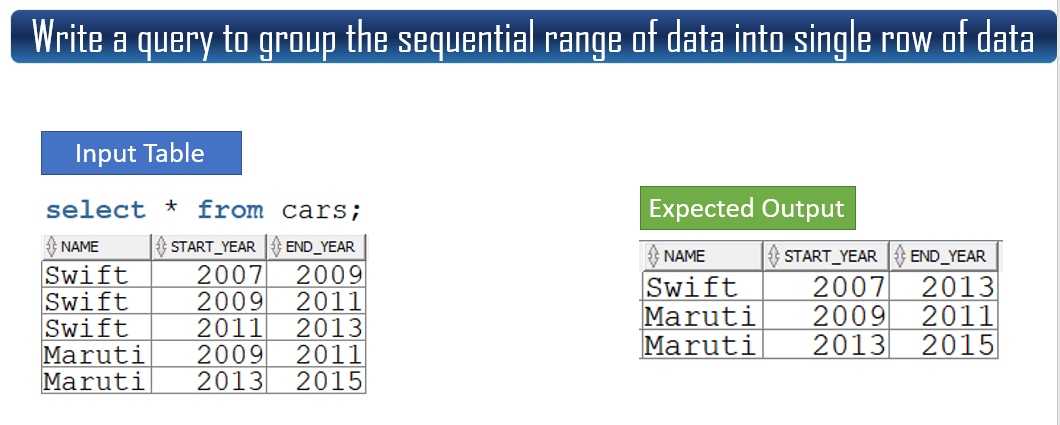
create table cars ( 
name varchar2(100),
start_year number,
end_year number);

insert into cars values('Swift',2007,2009);
insert into cars values('Swift',2009,2011);
insert into cars values('Swift',2011,2013);
insert into cars values('Maruti',2009,2011);
insert into cars values('Maruti',2013,2015);


commit;

with r as (select distinct name,start_year+r year
from cars,
lateral(select rownum-1 r 
        from dual connect by level <=end_year-start_year+1)
order by 1,2)
select name,min(year) s_year,max(year) e_year
from r
group by name,year-rownum;

Saturday, September 14, 2019

Expand and Fill the missing dates with last not null value


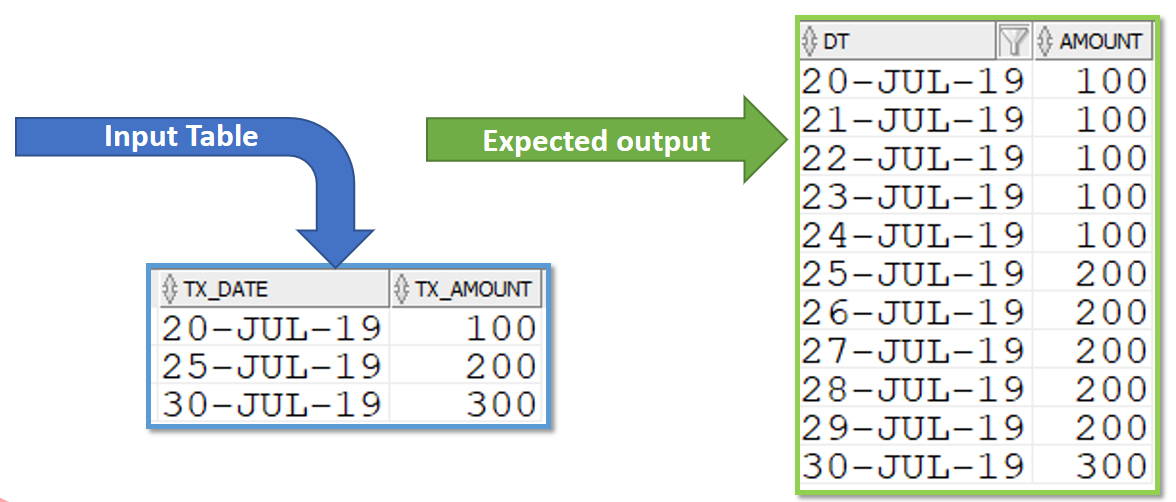
Input and Expected Output:


Data Setup:

create table tx_data(dt date, amnt number);

insert into tx_data values(to_date('20-JUL-2019','DD-MON-YYYY'),100);
insert into tx_data values(to_date('25-JUL-2019','DD-MON-YYYY'),200);
insert into tx_data values(to_date('30-JUL-2019','DD-MON-YYYY'),300);

commit;

Query:

with d1 as (
select min(dt) mi,max(dt) mx, max(dt)-min(dt) num
from tx_data),
dt_range as (select level-1+mi dt
from d1
connect by level <=num+1)
select dt_range.dt,
       last_value(amnt ignore nulls) over(order by dt_range.dt) amnt
from dt_range left outer join tx_data
on (dt_range.dt = tx_data.dt)

order by 1;